





Forefront positions itself as a large-scale combined-arms shooter built explicitly for virtual reality, promising the kind of massive battles traditionally reserved for flat-screen multiplayer games. Tanks roll across open terrain, helicopters dominate the skyline, and dozens of players clash across expansive maps. Yet beneath this ambition lies a fundamental design tension: virtual reality amplifies human-scale perception in ways that clash with traditional battlefield abstractions. This article examines how Forefront grapples with translating large-scale warfare into VR, and how issues of scale, distance, visibility, and embodiment redefine what “battlefield design” means when the player is physically present inside the conflict.
1. The First Deployment and the Shock of Physical Scale
The opening moments of a Forefront match are disorienting.
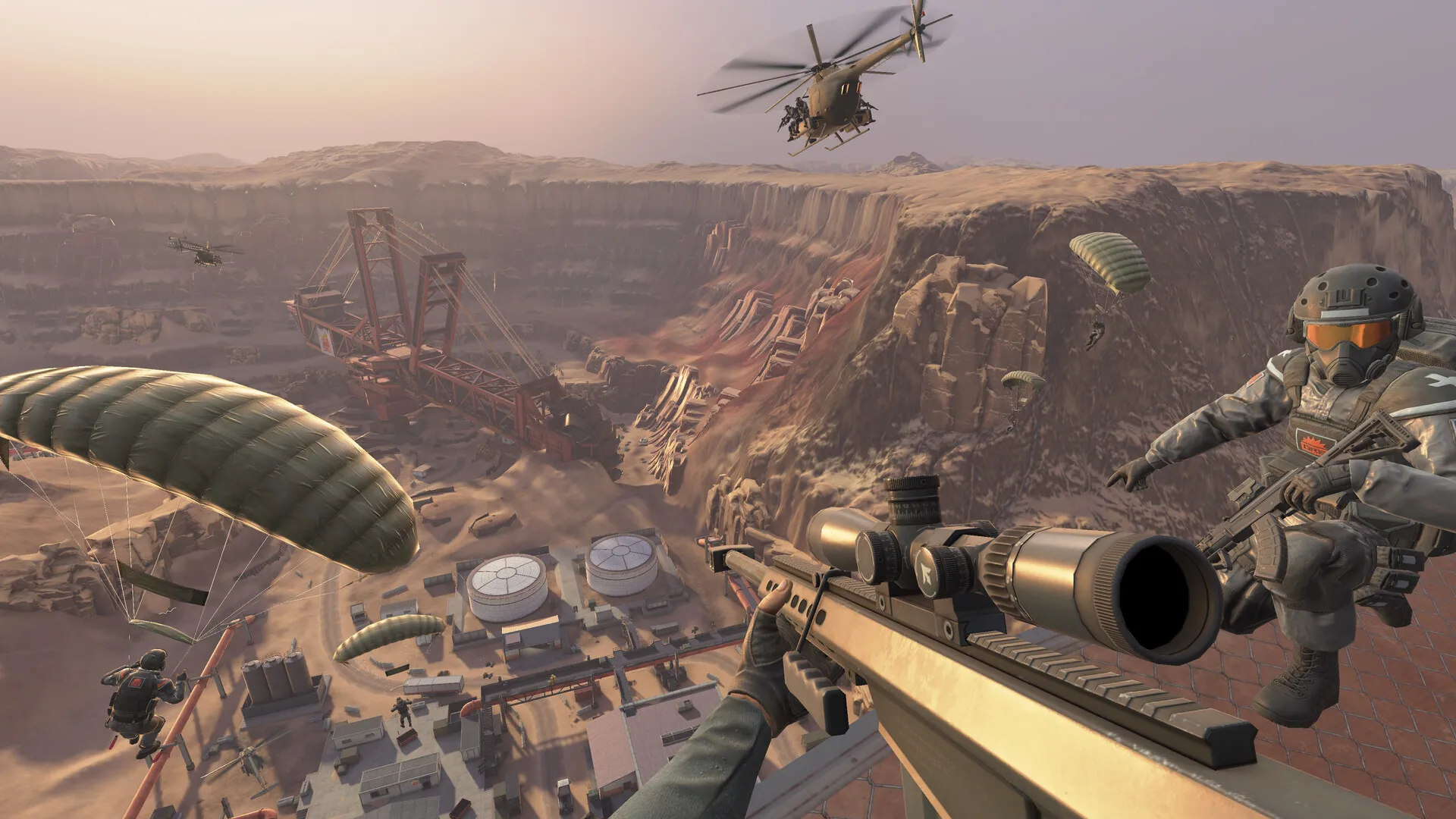
Players spawn into environments that feel enormous, not because of map size alone, but because VR restores true spatial proportion. A hill is no longer a texture; it is a climb. A vehicle is no longer an icon; it is a looming object.
This immediately reframes expectations. Traditional FPS instincts about distance, cover, and movement no longer apply cleanly, creating a learning curve rooted in perception rather than mechanics.
2. Human Eye-Level Changes Battlefield Readability
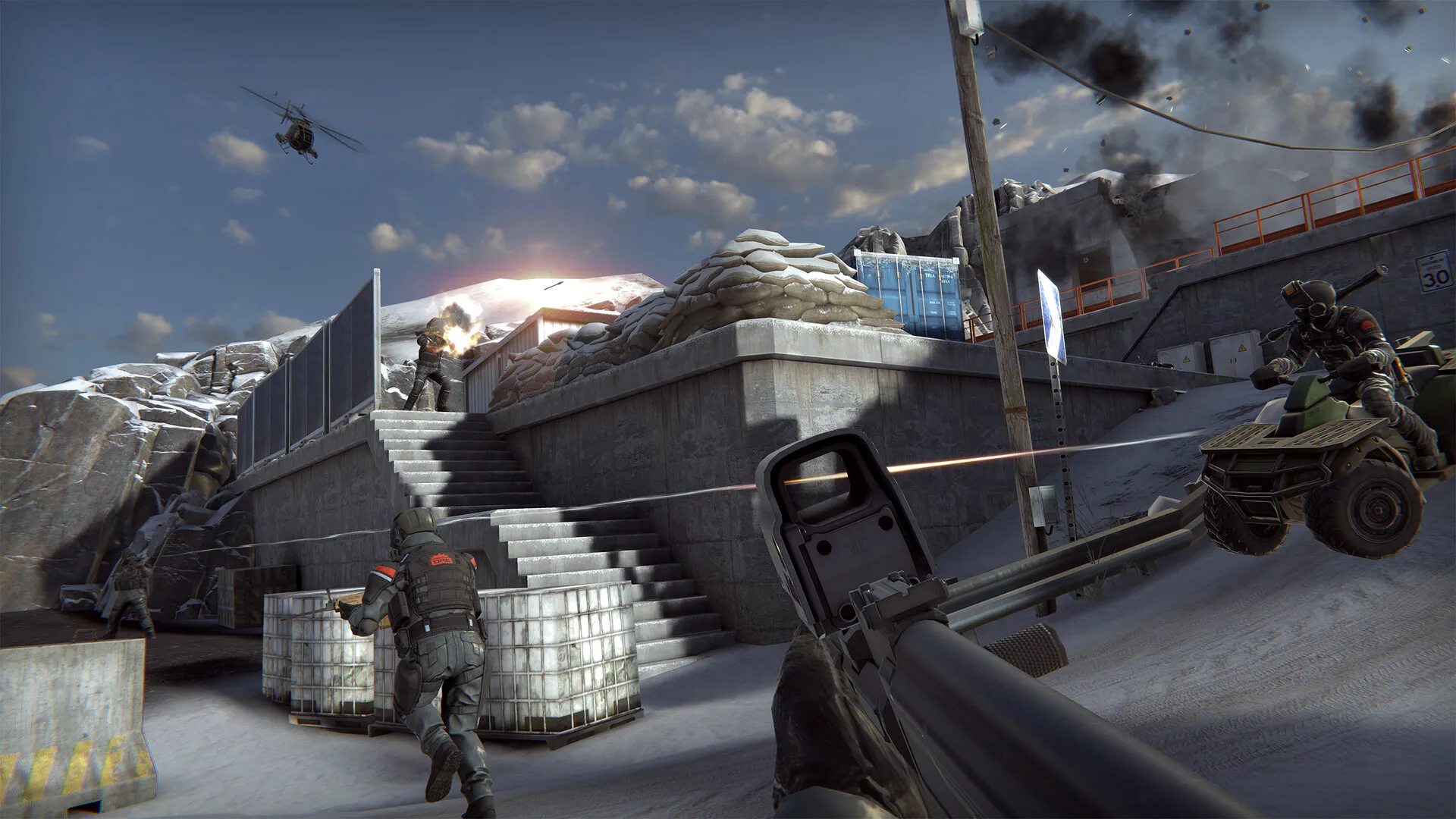
In flat-screen shooters, the camera floats unnaturally.
In Forefront, the camera is the player’s head, locked to human height and movement.
Eye-level constraint
This restriction reduces omniscience and makes battlefield awareness fundamentally local rather than global.
3. Long-Distance Combat Loses Abstract Clarity
Large maps depend on readable long-range engagements.
In VR, distant enemies become harder to parse due to realistic depth, scale compression, and limited visual acuity.
Distance ambiguity
What appears tactically clear on a monitor becomes perceptually vague in VR space.
4. Vehicles as Spatial Dominators, Not Balance Pieces
Tanks and helicopters feel overwhelming in VR.
Their physical presence generates intimidation that exceeds their mechanical power.
Embodied threat
Vehicles dominate emotionally before they dominate statistically.
5. Cover Design Must Account for Physical Body Language
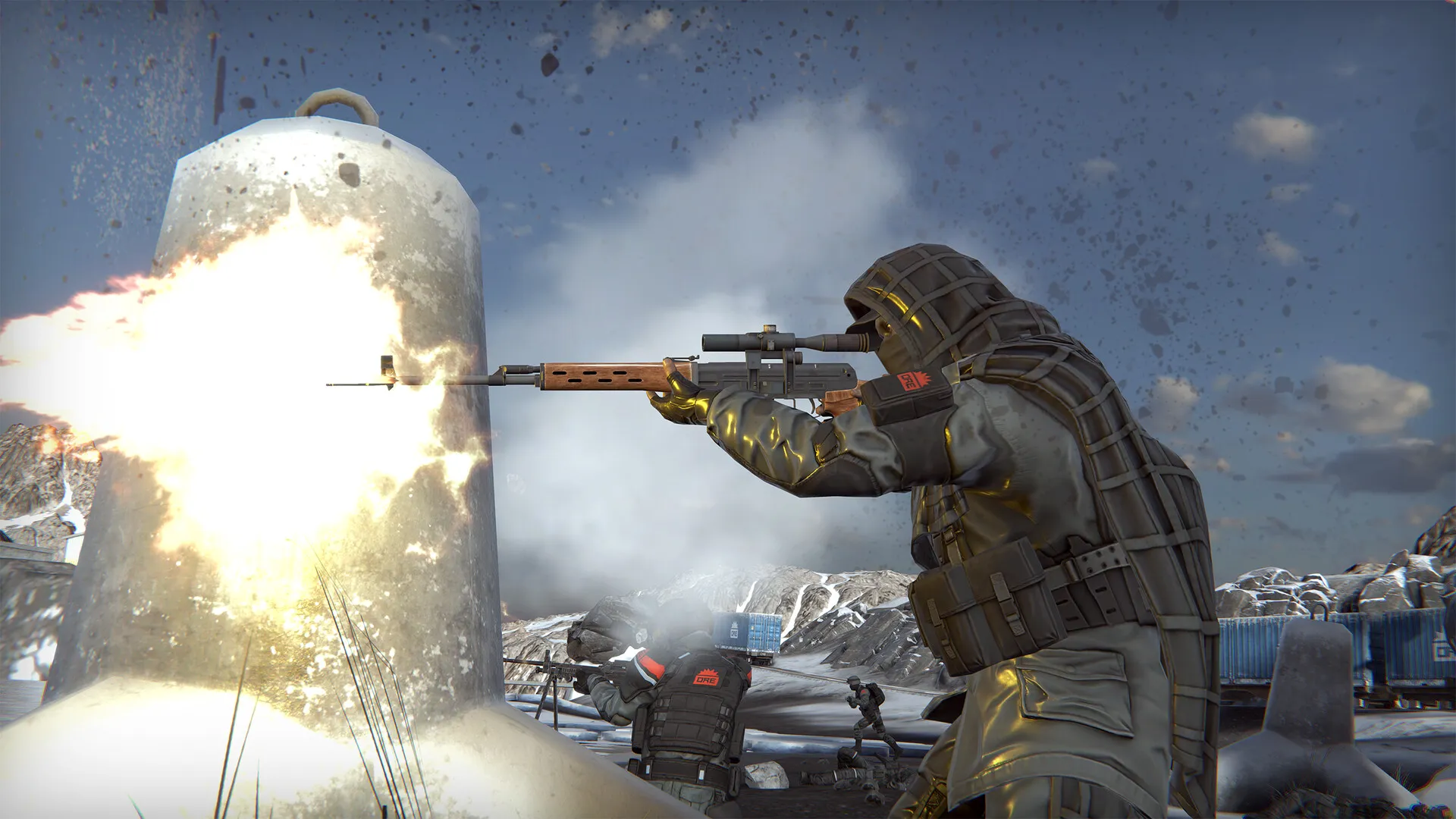
Cover in VR is not binary.
Players lean, crouch, and peek naturally, introducing infinite micro-positions.
Analog exposure
Traditional cover logic breaks under continuous movement.
6. Navigation Fatigue in Expansive Maps
Large-scale maps demand traversal.
In VR, movement carries physical and cognitive cost.
Traversal exhaustion
Distance becomes tiring before it becomes strategic.
7. Respawn and Death Feel More Personal
Dying in VR is abrupt and intimate.
The loss of bodily presence makes death feel heavier than a screen fade.
Psychological impact
Repeated deaths erode player confidence faster in VR.
8. Audio as a Primary Spatial Survival Tool
Visual overload limits situational awareness.
Audio cues become essential for threat detection and orientation.
Sound-based mapping
Players build mental maps through sound rather than sight.
9. Squad Coordination Under Embodied Constraints
Communication changes when players inhabit bodies.
Gestures, head movement, and physical proximity matter.
Embodied teamwork
Coordination becomes human rather than abstract.
10. Why Battlefield Design Must Be Rewritten for VR
Forefront exposes a core truth.
Large-scale shooter design cannot be directly ported into VR.
Success depends on reconciling human perception with strategic abstraction, not scaling numbers upward.
Conclusion
Forefront is less a finished statement than an ongoing experiment in translating battlefield scale into virtual reality. Its greatest challenge lies not in performance or content, but in reconciling human perception with systems built for disembodied cameras. By placing players physically inside massive conflicts, the game reveals how traditional shooter design relies on abstractions VR refuses to preserve. Whether Forefront ultimately succeeds or not, it plays a crucial role in demonstrating that large-scale VR warfare requires entirely new design language—one grounded in embodiment, perception, and human limitation rather than map size alone.