The Physics of Chaos: Deconstructing the Ragdoll Mechanics and Collision Logic in Dude Theft Wars

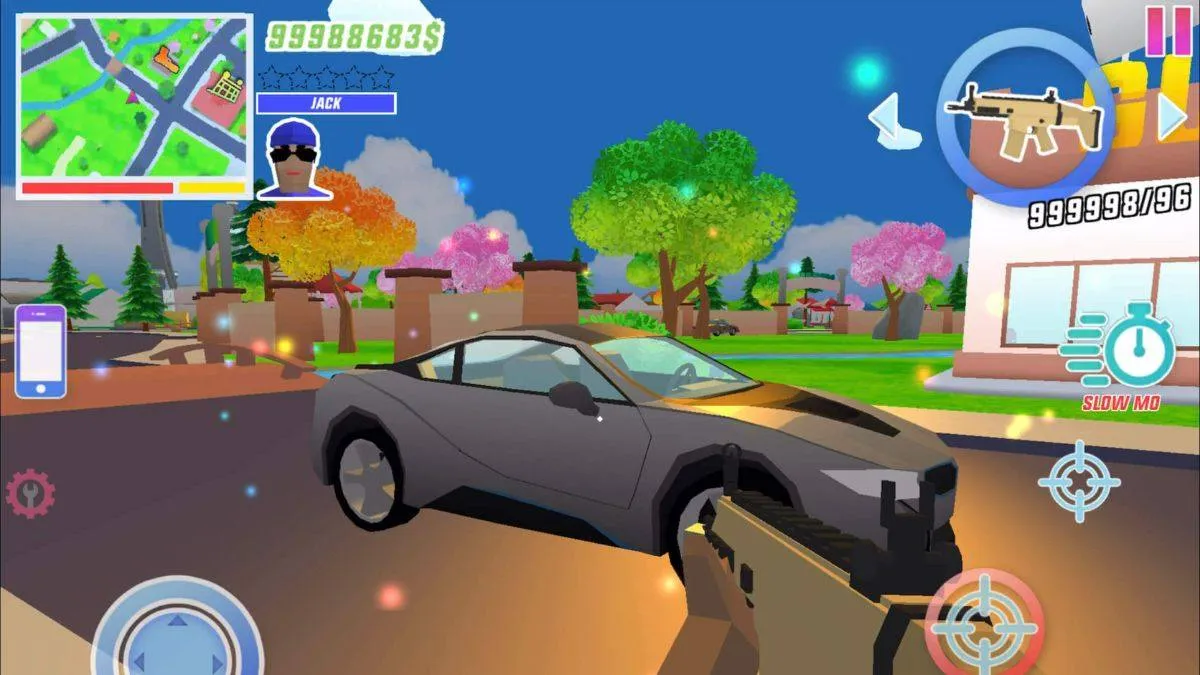
Dude Theft Wars has carved out a massive niche in the mobile gaming market by leaning into the "sandbox of absurdity." While many titles attempt to mimic the high-fidelity realism of triple-A open-world games, Poxel Studios took the opposite approach. They embraced a low-poly aesthetic and paired it with an unpredictable, high-energy physics engine. However, the game’s greatest strength is also its most complex technical hurdle: the Ragdoll Physics System. This specific element dictates everything from how Jack (the protagonist) reacts to a car crash to how NPCs fly across the map after an explosion. Understanding the deep mechanical interplay between collision layers and kinetic energy in this game reveals why it feels so uniquely chaotic compared to its peers.
The Genesis of "Dude" Physics: Primitive Voxel Colliders
In the early stages of Dude Theft Wars, the developers had to establish how basic shapes would interact in a 3D space without melting mobile processors. The game uses a simplified collider mesh system. Instead of calculating the exact skin of a low-poly character, the engine wraps entities in "primitive colliders"—mostly capsules and boxes. This is why you sometimes see Jack "float" slightly above a slanted roof or clip through the corner of a dumpster.
These primitives are the foundation of the game's performance. By reducing a complex character model into a series of five or six basic geometric shapes, the game can handle dozens of NPCs on screen simultaneously. However, this simplification creates the "overlap" issue, where two colliders occupy the same space for a split second, leading to the explosive "pop" effect that players often use to launch themselves into the air.
The Transition Phase: From Static Animation to Active Ragdoll
One of the most fascinating specific issues in Dude Theft Wars is the transition state between a standard "walking" animation and the "ragdoll" state. In most games, this is a binary switch: you are either animated or you are a physics object. In Dude Theft Wars, there is a micro-delay where the game calculates the force of impact before letting go of the skeletal constraints.
Key Factors in State Transition:
- Velocity Threshold: The minimum speed at which a vehicle must hit a "Dude" to trigger the ragdoll state.
- Force Vectoring: How the engine determines the direction of the "tumble" based on the point of contact.
- Recovery Timer: The algorithmic countdown that determines when Jack stands back up.
This transition is often where the most hilarious bugs occur. If a player is hit by two forces at the exact moment of transition, the skeletal mesh can "stretch," leading to the infamous "Long-Neck Jack" glitch that has become a staple of the community’s meme culture.
Kinetic Energy Distribution in Explosive Chain Reactions
Explosions in Dude Theft Wars don't just deplete a health bar; they act as a "Force Origin Point." When a grenade detonates, the game radiates a sphere of kinetic energy. The issue here is how that energy is distributed across multiple objects. Unlike realistic simulators, Dude Theft Wars uses a linear falloff that often favors the "spectacle" over accuracy.
This means a car twenty feet away might fly further than an NPC five feet away, depending on the weight variables assigned to the objects. This inconsistency is actually a design choice. It ensures that every explosion results in a chaotic, unpredictable screen-fill of flying assets, which keeps the gameplay loop of "causing mayhem" feeling fresh and rewarding for the player.
Vehicle Suspension and High-Speed Collision Logic
The vehicles in Dude Theft Wars are not just moving boxes; they have a surprisingly complex (if exaggerated) suspension system. Each wheel acts as an independent raycast that detects the distance to the ground. When you take a ramp at high speed, the physics engine has to reconcile the upward momentum with the gravity constant.
Vehicle Interaction Layers:
- Chassis Collider: The main body that takes damage.
- Wheel Raycasts: The points that handle friction and turning.
- Passenger Anchors: The invisible points where Jack "snaps" to the seat.
The specific issue occurs when the Chassis Collider touches the ground before the Wheel Raycasts. This causes the game to think a "collision" has occurred rather than "driving," often resulting in the car flipping uncontrollably or getting stuck inside the pavement.
Gravity Scaling and the "Moon Jump" Phenomenon
Gravity in Dude Theft Wars is not a constant $-9.81 m/s^2$. It is a variable that the game scales based on player activity. When you use the "Moon Gravity" cheat or certain power-ups, the engine doesn't just lower the gravity; it alters the air friction (drag) of the ragdoll models.
This creates a specific mechanical issue: the "Infinite Momentum" glitch. If you jump while the gravity scale is shifting, the game occasionally forgets to re-apply drag. This leads to Jack flying across the entire map of Dude-o-polis with a single jump. While technically a bug, it highlights the loosely coupled nature of the game's physics variables, allowing for player-driven emergent gameplay.
NPC Pathfinding vs. Physics Interruption
NPCs in the game follow a simple NavMesh—a "blue carpet" of logic that tells them where they can walk. However, when a player drives a car into a crowd, the NavMesh logic is immediately interrupted by the Physics Engine. This "brain-to-body" handoff is a source of significant technical depth.
When the NPC is in ragdoll mode, the NavMesh is ignored. Once they stop moving, the game attempts to find the nearest "valid" point on the NavMesh to stand them back up. If you launch an NPC onto a roof where no NavMesh exists, they often enter a "loop" state, twitching as the AI tries to find a path back to the sidewalk. This interaction between logic layers is what makes the sandbox feel both fragile and hilarious.
The "Sticky" Collision Issue and Friction Constants
A frequent deep-level complaint or observation in the community is the "Sticky Wall" effect. In many areas of the map, if you drive or run into a wall at a specific angle, the friction constant becomes so high that the player becomes "glued" to the surface. This happens because the engine is calculating multiple collision points simultaneously.
Types of Friction in Dude Theft Wars:
- Static Friction: Prevents you from sliding down hills when standing still.
- Kinetic Friction: Slows you down when sliding across the pavement.
- Zero-Friction Zones: Specifically coded areas like the slides in the park.
The "stickiness" occurs when the Static Friction is accidentally applied while the player still has high Kinetic Velocity. It’s a mathematical "tug-of-war" that usually ends with the player having to reset their position or use an explosion to break the lock.
Procedural Animation Overlays on Ragdoll Models
To make the ragdolls feel less like "dead weight," the game uses procedural animation overlays. Even when Jack is tumbling through the air, you’ll notice his limbs flailing. This isn't a pre-recorded clip; it’s a procedural "IK" (Inverse Kinematics) system trying to reach for nearby surfaces.
This system is meant to help Jack "catch" himself on ledges. However, when the physics are moving too fast, the IK system sends conflicting data to the ragdoll joints. This results in the "spasm" effect where a character's legs might spin 360 degrees. While visually broken, it’s a testament to the game's attempt to layer "active" life over "passive" physics.
Optimization of Physics "Sleep" States
To keep mobile devices from overheating, Dude Theft Wars utilizes "Physics Sleeping." When an object—like a trash can or a knocked-over light pole—stops moving for a few seconds, the engine stops calculating its physics. It becomes a static object until something hits it again.
The specific issue here is the "Wake-Up Latency." Sometimes, you can walk through an object that is "sleeping" because the engine hasn't realized a collision is happening yet. This leads to the player getting trapped inside objects as they "wake up" and re-solidify. Managing these sleep states is the unsung hero of the game's optimization, allowing it to run on older hardware.
Conclusion: The Beauty of Imperfect Systems
Dude Theft Wars is a masterclass in how "imperfect" physics can create a more engaging experience than "perfect" ones. The specific issues regarding ragdoll transitions, collision stickiness, and kinetic distribution aren't just technical flaws; they are the ingredients of the game's identity. By allowing the physics engine to be "loose" and unpredictable, Poxel Studios created a playground where every player's experience is slightly different.
Ultimately, the game thrives because it doesn't take its own rules too seriously. It provides a framework of voxel-based gravity and collision, then gives the player the tools to break that framework. Whether you are launching a car into the stratosphere or watching an NPC glitch through a wall, you are witnessing a complex dance of code that prioritizes fun and absurdity over the rigid constraints of reality